
Research Notice: Research cited on this page is independent, peer-reviewed scientific work. BGREEN and Turtlegym products are wellness and lifestyle equipment — they are not medical devices and are not intended to diagnose, treat, cure, or prevent any medical condition. Findings from independent research do not constitute claims about Vibrahealth products. Persons with health conditions should consult a qualified healthcare professional before use.
Whole Body Vibration and Sarcopenia: What a 2025 Study in Scientific Reports Found
Sarcopenia — the age-related loss of skeletal muscle mass, strength, and physical function — is one of the defining health challenges of an ageing population. It is associated with falls, hospitalisation, loss of independence, and increased mortality. For older adults and the healthcare professionals who support them, finding safe, practical interventions to slow or counter sarcopenia is a significant clinical priority.
In 2025, researchers published a study in Scientific Reports — a peer-reviewed, open-access journal published by Nature Portfolio — examining whether whole-body vibration (WBV) could serve as an effective intervention for sarcopenia-related outcomes in older adults.
About the Study
The study was authored by Zhuang and colleagues and published in Scientific Reports in 2025. Scientific Reports is one of the world’s largest multidisciplinary open-access journals, operated by the same publisher as Nature, and applies rigorous peer review to research across the biological and medical sciences.
The study sits within a growing body of research exploring non-pharmacological, low-impact physical interventions for older adults — particularly those who cannot safely undertake conventional resistance training or high-intensity exercise.
Why Sarcopenia Matters in Ageing
To understand the significance of this research, it is important to understand what sarcopenia involves. Adults typically begin losing skeletal muscle mass from their fourth decade of life, with the rate of loss accelerating after age 60. By age 80, many individuals have lost between 30% and 50% of their peak muscle mass.
The consequences extend well beyond reduced strength. Sarcopenia impairs balance and gait, dramatically increasing fall risk. It reduces metabolic function, contributing to insulin resistance and cardiovascular risk. And it degrades the quality of daily life — making tasks like rising from a chair, climbing stairs, or carrying groceries progressively harder.
Standard interventions for sarcopenia include resistance training and protein supplementation. However, frailty, joint pain, cardiovascular limitations, and cognitive decline make conventional exercise impractical for many of the older adults most at risk.
What the Researchers Examined
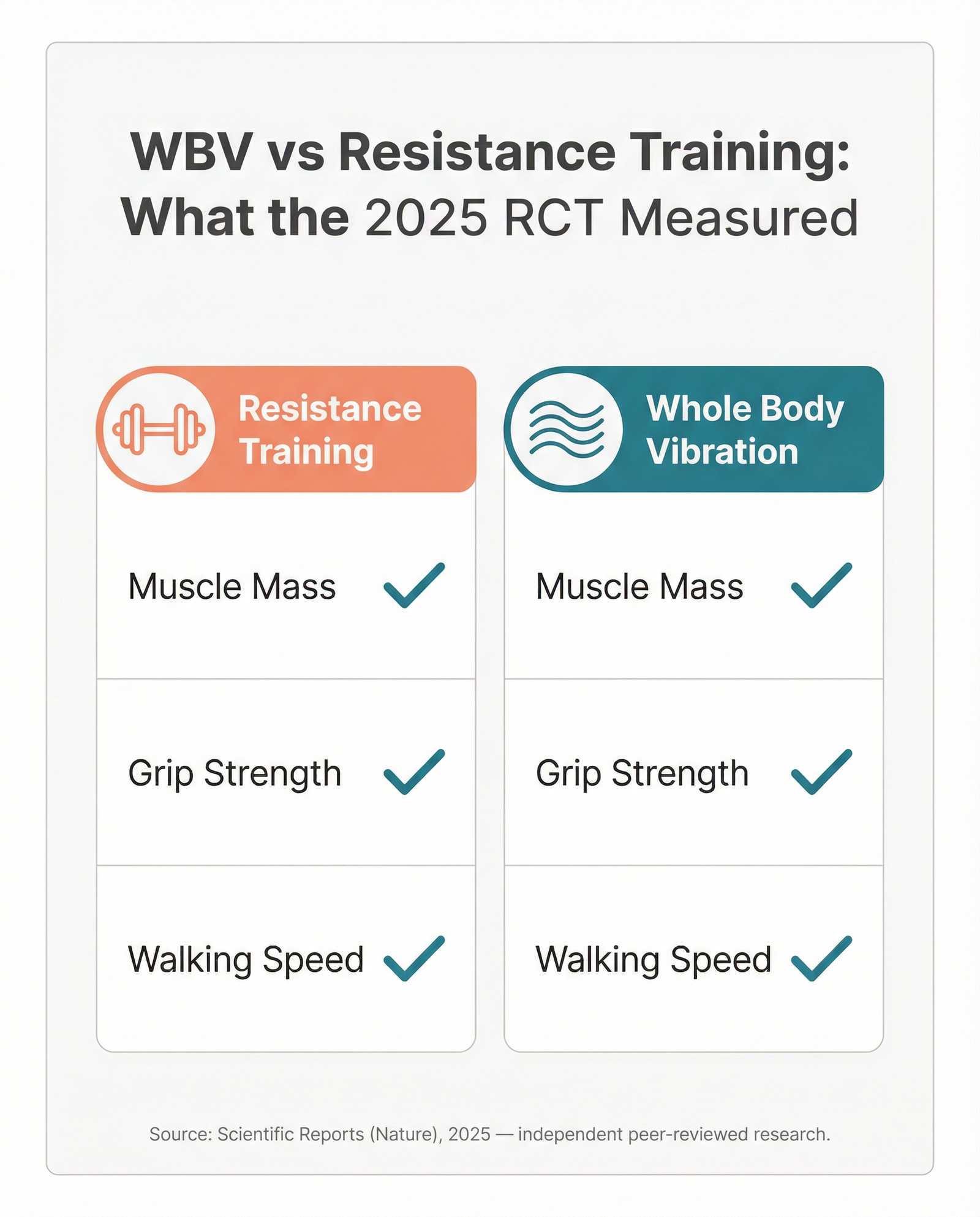
The research examined the effects of WBV on muscle-related and functional outcomes associated with sarcopenia. The study assessed parameters relevant to the clinical picture of sarcopenia, including measures related to muscle performance and physical function.
Whole-body vibration delivers mechanical oscillations through a vibrating platform, transmitting a stimulus to the musculoskeletal system without requiring the participant to generate voluntary force against an external load. This low-demand nature is precisely what has drawn researchers to study WBV in populations where conventional exercise is difficult or contraindicated.
What the Researchers Found
The study reported positive effects of WBV intervention on sarcopenia-related outcomes in the older adult population studied. Researchers observed improvements in the parameters they assessed following the WBV protocol, supporting the hypothesis that vibration-based exercise may represent a viable strategy to address components of sarcopenia in ageing individuals.
The findings add to an accumulating evidence base suggesting that WBV may offer a practical alternative or complement to conventional exercise for older adults facing the challenges of age-related muscle loss.
Limitations and Context
As with all single studies, these findings should be understood within their methodological context. The specific population, WBV protocol parameters (frequency, amplitude, session duration, and total programme length), and outcome measures all influence the results. Further research and replication across diverse cohorts will continue to build the evidence base.
WBV is not a medical treatment. The research examines WBV as a physical stimulus and its effects on physiological parameters. It does not examine BGREEN or Turtlegym products specifically, and no findings from this or any independent study constitute claims about commercial wellness equipment.
Why This Is Relevant to Singapore’s Ageing Population
Singapore’s resident population is ageing rapidly. By 2030, one in four Singaporeans will be aged 65 or older. Sarcopenia is already a significant burden on the healthcare system and on family caregivers — and the demand for practical, low-barrier physical activity options for older adults is only increasing.
Research such as this informs the conversation healthcare professionals, eldercare managers, and health-conscious individuals are having about evidence-based options for active ageing. For those managing residential care facilities or advising older patients, a 2025 publication in a Nature Portfolio journal provides a credible contemporary reference.
Learn More
The technology examined in this research — whole-body vibration — is what BGREEN products are built around. Our Science page explains the mechanism behind WBV in accessible language for healthcare professionals and non-specialists alike.
For eldercare and healthcare B2B enquiries, visit our Healthcare Partners page. To experience the technology directly, complimentary sessions are available at our Wellness Lounge at The Adelphi, Singapore.
BGREEN and Turtlegym products are wellness and lifestyle equipment — not medical devices.
Source
- Zhuang Y et al. (2025). Whole-body vibration as an intervention for sarcopenia-related outcomes in older adults. Scientific Reports. https://doi.org/10.1038/s41598-025-91644-2
For the full research topic overview, visit our Research Library.