Research Notice: Research cited on this page is independent, peer-reviewed scientific work. BGREEN and Turtlegym products are wellness and lifestyle equipment — they are not medical devices and are not intended to diagnose, treat, cure, or prevent any medical condition. Findings from independent research do not constitute claims about Vibrahealth products. Persons with health conditions should consult a qualified healthcare professional before use.
Whole Body Vibration for Chronic Low Back Pain: What a 2019 Study Found
Chronic low back pain (CLBP) is one of the most prevalent and disabling musculoskeletal conditions worldwide. It affects people across age groups — from working-age adults to the elderly — and is a leading cause of lost productivity, disability, and healthcare utilisation. In Singapore, musculoskeletal conditions are among the top reasons for specialist outpatient visits and work absence.
Standard management for chronic low back pain typically includes physiotherapy, exercise rehabilitation, manual therapy, and pharmacological pain management. Researchers continue to investigate additional or complementary strategies — particularly for individuals who struggle to engage in conventional exercise due to pain or physical limitation.
In 2019, Zheng and colleagues published a study in Medical Science Monitor — a peer-reviewed international journal of experimental and clinical research — examining whole-body vibration (WBV) as an intervention for chronic low back pain.
About the Study
Medical Science Monitor is an international, peer-reviewed journal published by International Scientific Information (ISI) and indexed on PubMed. It covers a broad range of clinical and experimental medicine, with particular focus on translational research that bridges laboratory findings and clinical application.
The 2019 study by Zheng and colleagues (volume 25, pages 443–452) investigated whether a structured WBV programme produced measurable effects on pain, functional outcomes, and related parameters in individuals with chronic low back pain.
The Challenge of Low Back Pain Rehabilitation
Chronic low back pain presents a rehabilitation challenge that conventional approaches do not always resolve adequately. The condition is multifactorial — influenced by structural changes in the spine, muscle weakness and imbalance, reduced proprioception, central sensitisation, and psychosocial factors.
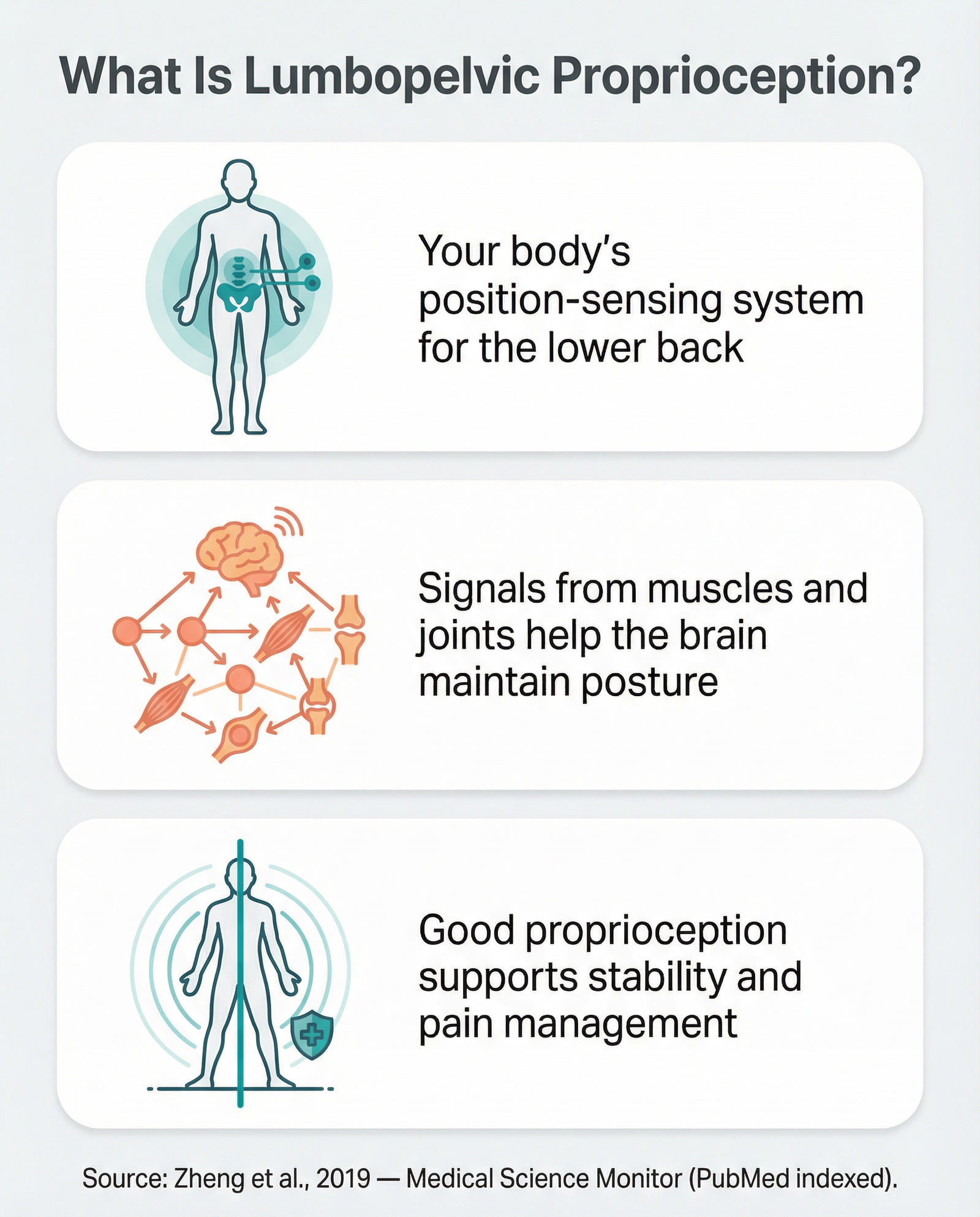
A key component of rehabilitation is addressing the neuromuscular deficits that accompany CLBP: weakened lumbar stabiliser muscles, impaired proprioception in the lumbopelvic region, and altered movement patterns that develop as the body adapts to pain. Exercises targeting trunk stability and spinal proprioception form the basis of most evidence-based rehabilitation programmes.
Whole-body vibration has been studied in this context because of its capacity to deliver a mechanical stimulus to the neuromuscular system — particularly the postural and stabilising muscles of the trunk — without requiring the participant to generate high-intensity voluntary effort against pain.
What the Researchers Examined
The study examined the effects of a WBV intervention on participants with chronic low back pain. The researchers assessed outcomes relevant to the CLBP clinical picture, including measures of pain intensity, functional capacity, and trunk muscle performance.
The WBV protocol involved structured sessions on a vibrating platform, and participants were assessed before and after the intervention period to measure changes from baseline across the outcomes of interest.
What the Researchers Found
The study reported positive effects of WBV on outcomes associated with chronic low back pain, including improvements in pain-related and functional parameters. Researchers observed that the WBV intervention group showed meaningful changes relative to their baseline assessments.
These findings align with the physiological hypothesis: WBV stimulates trunk and lumbar stabiliser muscles, activates proprioceptive input from the spinal region, and delivers a mechanical loading stimulus that — over a structured programme — may contribute to improvements in the neuromuscular profile underlying chronic low back pain.
Interpreting the Evidence
CLBP is heterogeneous. Chronic low back pain encompasses a wide range of underlying causes and presentations. WBV research in CLBP should be interpreted in the context of the specific population studied — participants’ age, pain chronicity, severity, and co-existing conditions all influence outcomes.
WBV is not a treatment for low back pain. The research examines WBV as a physical stimulus and its effects on pain and functional parameters in a specific study cohort. It does not examine BGREEN products specifically, and the findings do not constitute medical claims about any wellness device.
WBV occupies a different role from targeted physiotherapy. This research should be understood as adding to the evidence base around low-impact physical activity options — not as evidence that WBV replaces structured physiotherapy or medical management of chronic pain conditions.
Relevance to Singapore’s Working and Ageing Population
Low back pain is a significant occupational and age-related health burden in Singapore. It is a leading cause of presenteeism and medical leave among working adults, and is increasingly common among older Singaporeans as disc degeneration and postural changes accumulate with age.
For physiotherapists, occupational health professionals, and wellness programme managers seeking evidence-based options to complement conventional care, peer-reviewed research on WBV and CLBP provides a relevant reference. A 2019 publication in a PubMed-indexed journal adds credibility to the case for including vibration-based physical activity in the broader toolkit for musculoskeletal health.
Learn More
Our Science page explains the mechanism behind WBV and how whole-body vertical vibration interacts with the musculoskeletal and neuromuscular systems. For those interested in experiencing the technology, complimentary sessions are available at our Wellness Lounge at The Adelphi, Singapore.
BGREEN and Turtlegym products are wellness and lifestyle equipment — not medical devices.
Source
- Zheng YL, Wang XF, Chen BL, Gu W, Wang X, Xu B, Zhang J, Wu M, Zhang XN, Chen CC, Lu W. (2019). Effect of 12-week whole-body vibration exercise on lumbopelvic proprioception and pain control in young adults with nonspecific low back pain. Medical Science Monitor, 25, 443–452. https://doi.org/10.12659/MSM.912047