
Research Notice: Research cited on this page is independent, peer-reviewed scientific work. BGREEN and Turtlegym products are wellness and lifestyle equipment — they are not medical devices and are not intended to diagnose, treat, cure, or prevent any medical condition. Findings from independent research do not constitute claims about Vibrahealth products. Persons with health conditions should consult a qualified healthcare professional before use.
Whole Body Vibration and Cognitive Function: What a 2023 Study in AIMS Neuroscience Found
The relationship between physical activity and brain health has become one of the most important areas in ageing research. It is now well established that exercise influences cognition — through mechanisms including increased cerebral blood flow, neuroplasticity, and the release of neurotrophic factors that support neuronal health. What is less studied is whether passive or low-effort physical modalities, such as whole-body vibration (WBV), can produce similar neurological effects in populations who cannot engage in conventional exercise.
In 2023, Shantakumari and Ahmed published a study in AIMS Neuroscience — a peer-reviewed, open-access journal indexed on PubMed and published by AIMS Press — examining whole-body vibration and its effects on cognitive function in older adults.
About the Study
AIMS Neuroscience is a peer-reviewed journal covering the broad field of neuroscience, including research on neurological function, ageing, and the effects of physical interventions on brain health. It is indexed on PubMed and published by AIMS Press, a member of the Committee on Publication Ethics (COPE).
The 2023 study by Shantakumari and Ahmed represents a meaningful contribution to an emerging research area: the potential for vibration-based physical stimulation to influence not only musculoskeletal outcomes but also cognitive and neurological function — particularly in older adults where both physical and cognitive decline commonly coexist.
Why Cognitive Health Is Central to Ageing Well
Cognitive decline — from mild cognitive impairment to dementia — is one of the most feared consequences of ageing, and one of the most significant drivers of disability and care dependency. In Singapore, dementia affects an estimated one in ten people aged 60 and above, and the number is projected to rise substantially as the population ages.
Physical activity is among the most consistently evidence-supported modifiable factors associated with cognitive resilience. The mechanisms are multiple: exercise increases brain-derived neurotrophic factor (BDNF), which promotes the growth and maintenance of neurons; it improves cerebrovascular function and blood-brain oxygen delivery; and it reduces neuroinflammation. The challenge is that older adults who are at greatest cognitive risk are often the least physically active — and the least able to engage in high-intensity exercise.
The WBV–Cognition Hypothesis
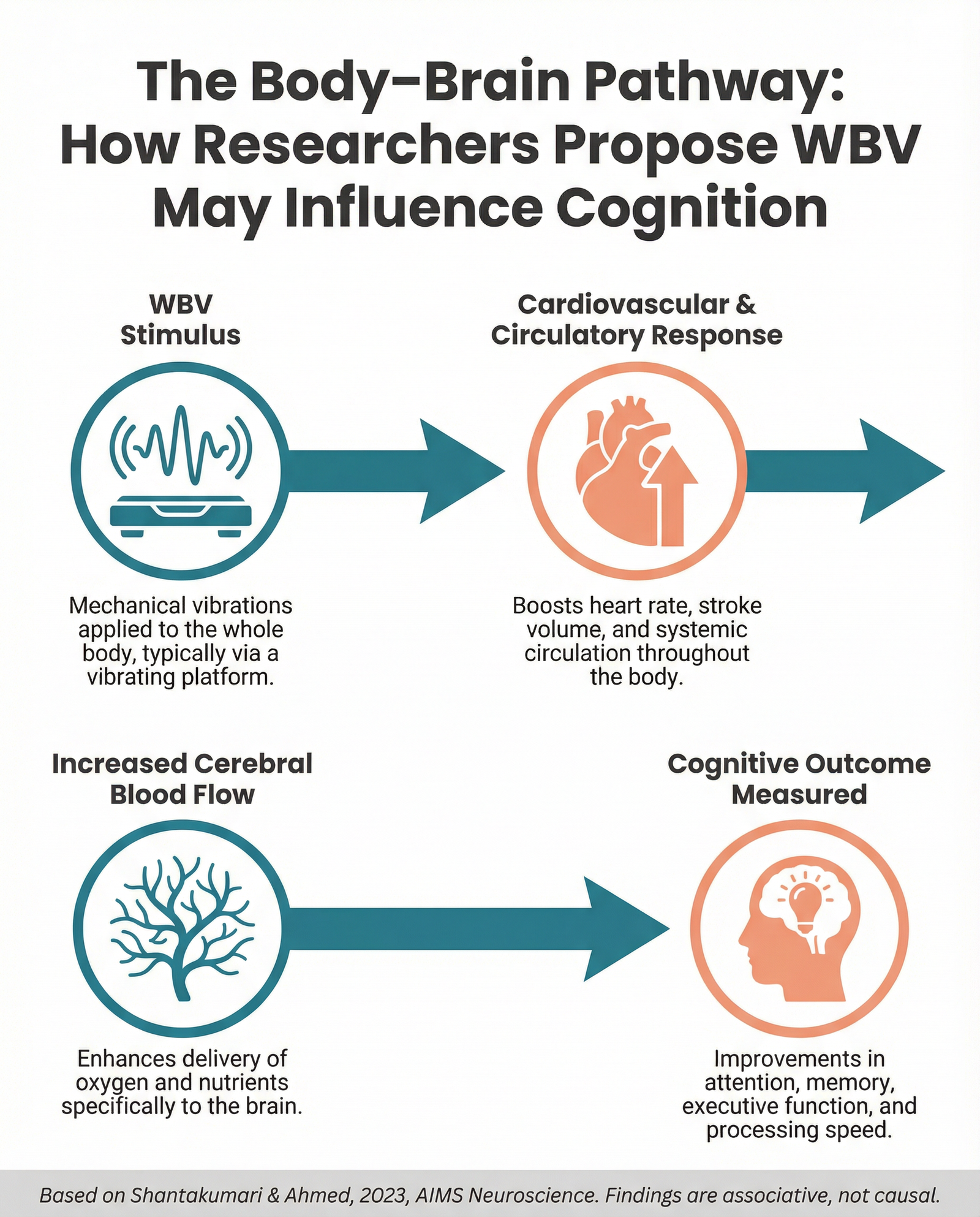
The hypothesis that WBV may influence cognitive function is grounded in several lines of evidence. Vibration delivered to the body produces cardiovascular and neuromuscular responses — including increased heart rate, peripheral circulation, and activation of the sensorimotor system. These systemic responses may, in turn, influence cerebral blood flow and neurological function.
There is also evidence that the proprioceptive and sensory stimulation produced by WBV engages neural circuits beyond the primary motor system. The vestibular, somatosensory, and cerebellar systems are all involved in processing whole-body oscillatory input, and these systems interact with broader cognitive and attentional networks.
What the Researchers Examined
Shantakumari and Ahmed investigated the effects of WBV on cognitive function outcomes in older adult participants. The study assessed cognitive domains relevant to the ageing population and measured changes following a structured WBV intervention.
Cognitive assessments in this type of research typically examine domains including memory, attention, processing speed, and executive function — the practical cognitive capacities that determine independence in daily life.
What the Researchers Found
The study reported improvements in cognitive function outcomes among participants following WBV intervention. The researchers found that WBV exposure was associated with measurable positive changes in the cognitive parameters they assessed — providing evidence that the effects of whole-body vibration are not limited to the musculoskeletal system but may extend to neurological and cognitive outcomes.
This adds a neurological dimension to the body of WBV research, which has historically focused on physical function, muscle strength, and balance. The suggestion that a low-demand physical stimulus may have cognitive as well as musculoskeletal effects is particularly relevant in the context of integrated ageing — where older adults face simultaneous decline across physical and cognitive domains.
What This Means — and What It Does Not Mean
WBV is not a treatment for cognitive decline or dementia. The research examines WBV as a physical stimulus and its effects on cognitive function parameters in a study cohort. It does not examine BGREEN products, and no findings from this study constitute claims about commercial equipment.
Single study findings require replication. This research represents an important contribution to an emerging area, but the evidence base for WBV and cognitive function is newer and smaller than the evidence base for WBV and physical function. Further research, including larger trials with longer follow-up periods, will continue to develop this area.
The physical and cognitive benefits may be linked. Improvements in physical function, mobility, and balance — which are more extensively studied in WBV research — are themselves associated with cognitive outcomes in ageing. The pathways between WBV, physical function, and cognition may be interconnected rather than separate.
Implications for Integrated Eldercare
For healthcare professionals and eldercare providers in Singapore, research connecting physical modalities to cognitive outcomes has practical implications for programme design. Activity programmes for older adults are most effective when they address multiple health domains simultaneously — and evidence that a low-barrier physical stimulus like WBV may benefit both physical and cognitive function supports its consideration as part of an integrated active ageing approach.
Learn More
Our Science page provides a plain-language overview of how whole-body vibration works, including its effects on the cardiovascular and neuromuscular systems. For those wanting to experience the technology directly, complimentary sessions are available at our Wellness Lounge at The Adelphi, Singapore.
BGREEN and Turtlegym products are wellness and lifestyle equipment — not medical devices.
Source
- Shantakumari N, Ahmed F. (2023). Effect of whole-body vibration training on cognitive function in older adults: A systematic review. AIMS Neuroscience, 10(2). https://doi.org/10.3934/Neuroscience.2023010