How to Talk to Your Parents About Exercise (Without Starting an Argument)
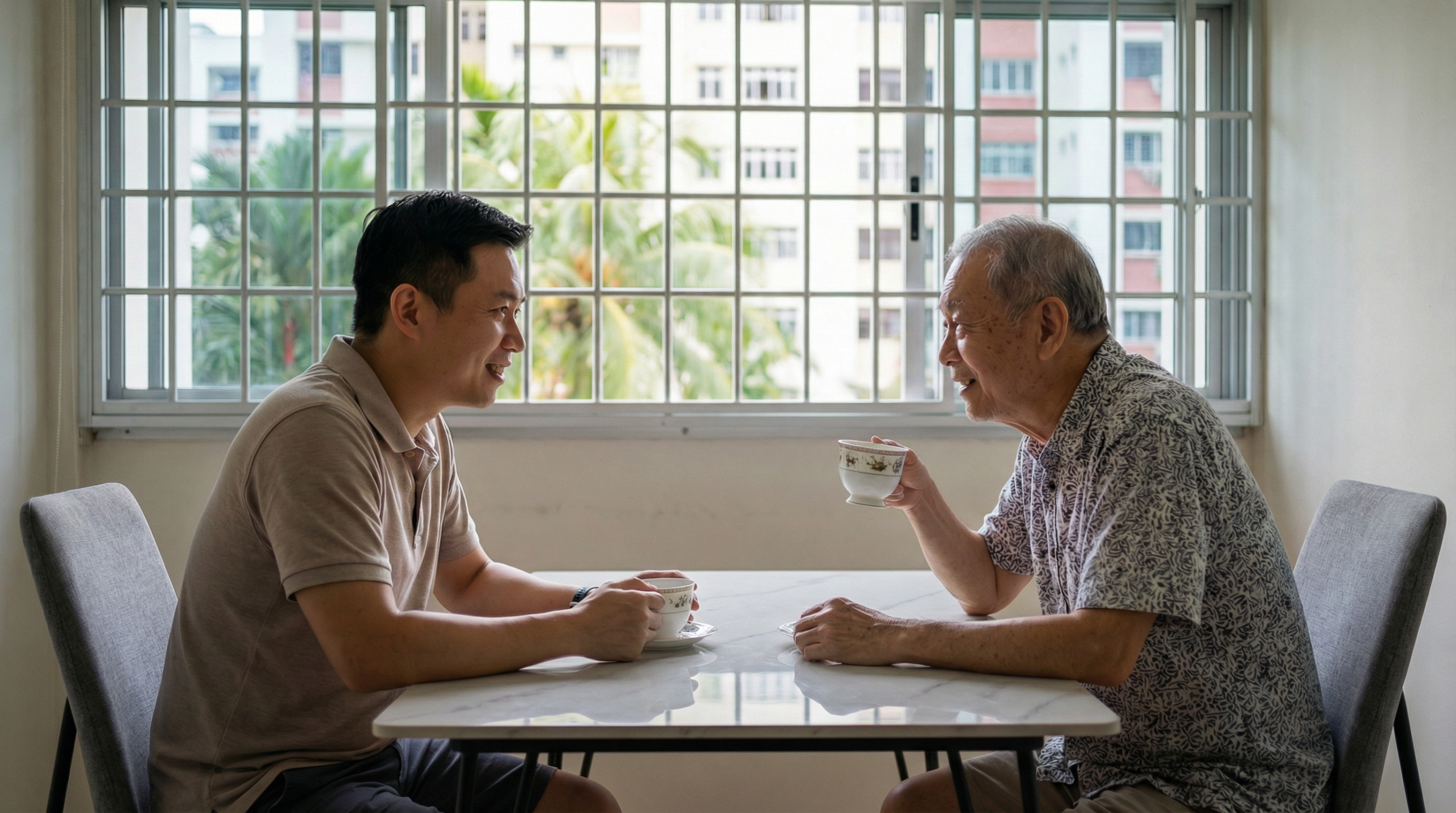
You have tried before. You mentioned it casually. You sent an article. You suggested a class. Maybe you offered to go with them. And the response was some version of: "I'm fine," "I don't need it," "stop worrying," or the classic Singaporean parental full-stop — silence.
Convincing an elderly parent to exercise is one of the most reliably frustrating experiences in adult caregiving. It is not because your parent does not care about their health. It is because the conversation is almost never really about exercise.
Understanding what is actually happening beneath the surface — and changing how you approach the conversation — makes an enormous difference.
Why These Conversations Usually Go Wrong
Most conversations about exercise with elderly parents fail for one of three reasons:
- The framing is wrong — "You need to exercise more" is a criticism disguised as advice. It implies the person is failing at something, which immediately triggers defensiveness.
- The solution is wrong for the person — suggesting a gym, a running routine, or a group fitness class to someone with knee pain and a fear of falling is not helpful advice. It is proof that you do not understand their situation.
- Autonomy is not respected — older adults, like all adults, do not respond well to being told what to do. The more pressure applied, the more resistance generated. This is not stubbornness. It is a normal human response to feeling managed.
None of this means the conversation should not happen. It means it needs to be approached differently.
What Is Really Behind the Resistance
Before the next conversation, it is worth thinking about what is actually driving your parent's reluctance. Common underlying reasons include:
- Fear of falling — this is more prevalent than most families realise. An older adult who has had a near-fall, or who knows someone who has fallen, often develops a cautious relationship with physical activity that feels like stubbornness but is actually self-protection.
- Pain or discomfort — joint pain, swollen legs, fatigue. When movement hurts, avoiding it is rational, not lazy.
- Embarrassment — many older adults feel ashamed of how their bodies have changed. They do not want to be seen struggling in a gym or slowing down a walking group.
- Feeling that it is too late — "What is the point at my age?" is a genuinely held belief for many older Singaporeans, especially those whose generation associated exercise with youth and sport rather than lifelong health maintenance.
- Not wanting to be a burden — accepting help, including help staying active, can feel like admitting decline. Some parents resist wellness efforts precisely because accepting them feels like a loss of independence.
Knowing which of these is driving the resistance changes everything about how you respond.
Language That Works — and Language That Does Not
A few specific language shifts that make a real difference in these conversations:
Instead of: "You need to exercise more"
Try: "I noticed you seemed a bit tired after we walked to [X]. Has getting around felt harder lately?"
This opens a conversation about how they feel, rather than what they should do. It also gives them an opportunity to raise concerns they may not have volunteered.
Instead of: "The doctor said you need to move more"
Try: "Would you be open to trying something gentle? Not a gym — just something that might make the mornings feel a bit less stiff."
Framing the activity in terms of an outcome they actually want (less stiffness, more energy) rather than a prescription they feel forced to follow.
Instead of: "I found a class / programme / device for you"
Try: "I came across something interesting. Would you want to come and have a look with me? No commitment — just curious to see what it's like."
The key shift here is shared curiosity rather than a recommendation to comply. You are not telling them what to do. You are inviting them on an exploration.
Instead of: "You should do this for your health"
Try: "I'd really love for us to be able to [specific activity] together for years to come. I think this might help with that."
Connecting wellness to something emotionally meaningful — a relationship, an activity, a shared future — is far more motivating than abstract health outcomes.
The "Low Threshold" Approach
One of the most effective strategies for resistant elderly parents is to remove as much friction from the first step as possible. Not "join a programme." Not "commit to three sessions a week." Just: come and try this one thing, one time.
This is where passive exercise options like whole body vibration are particularly useful in these conversations. The pitch to a resistant parent looks completely different from the pitch for conventional exercise:
- No exertion required — you sit down, the technology does the work
- No activewear, no warm-up, no journey to a gym
- 15 minutes — that is all
- A comfortable, quiet environment — not a gym floor full of younger people
- No commitment to continue — just come and see how it feels
For parents who have resisted every other suggestion, this framing often opens a door. It does not ask them to change their identity, their routine, or their beliefs about exercise. It just asks them to sit in a chair for 15 minutes.
Many of the older adults who are now regular Vibrahealth visitors came in the first time under significant protest, shepherded by an adult child who said "just try it once." After the session, most of them asked when they could come back.
When the Conversation Becomes About More Than Exercise
Sometimes the exercise conversation is a proxy for a bigger conversation: about ageing, about independence, about the fear of becoming a burden, about mortality. These are among the hardest conversations families have — and they rarely happen cleanly or all at once.
A few principles that apply to all of them:
- Listen more than you speak — the goal of the first conversation is usually not to change behaviour. It is to understand where your parent actually is.
- Do not rush to fix — the urgency is usually felt more strongly by the adult child than the parent. Acting from that urgency tends to make things worse.
- Acknowledge what they are managing — "I know your knees have been really uncomfortable lately" lands differently than "you need to move more despite the pain."
- Make it about the relationship — caregiving conversations go better when both people feel they are on the same side. Not parent vs. child. Not patient vs. concerned relative. Just two people who love each other, trying to figure something out together.
A Practical Starting Point
If you are looking for a low-friction first step that takes the pressure off the conversation, consider inviting your parent to a complimentary session at the Vibrahealth Wellness Lounge at The Adelphi. The experience speaks for itself in a way that no amount of explaining does — and it reframes "exercise" as something that requires no effort from them at all.
Alternatively, our gift options for elderly parents are designed for exactly this situation — for adult children who want to offer something meaningful without triggering another argument about health.

Frequently Asked Questions
How do I convince my elderly parent to exercise when they refuse?
Avoid framing it as exercise. Instead, focus on specific outcomes they care about — sleeping better, less morning stiffness, being able to walk to the market comfortably. Offer a single, low-commitment first step (not a programme) and let the experience do the persuading. Passive exercise options like whole body vibration are particularly useful because they require no exertion.
Why do elderly people refuse to exercise?
Common reasons include fear of falling, chronic pain or joint discomfort, embarrassment, a belief that exercise is no longer relevant at their age, and not wanting to admit decline. Understanding the specific underlying reason in your parent's case is more useful than trying a general approach.
How do I talk to my parents about their health without causing conflict?
Lead with curiosity rather than recommendations. Ask how they are feeling before offering solutions. Frame wellness activities in terms of outcomes they personally value. And accept that the first conversation rarely achieves immediate change — building a habit of honest, caring conversation is more valuable than winning a single argument.
What is the best exercise for an elderly parent who is resistant to physical activity?
The best exercise is the one they will actually do. For resistant older adults, this almost always means something with zero exertion, zero barrier to start, and no resemblance to a "workout." Seated whole body vibration (passive exercise), gentle stretching while watching television, and short walks as part of an existing routine are all good starting points for resistant individuals. Our products are wellness equipment and are not medical devices.
Vibrahealth offers complimentary sessions at our Wellness Lounge at The Adelphi, 1 Coleman Street, Singapore. If you would like to bring your parent for a no-pressure first experience, WhatsApp us to book or visit our Contact page.