Research Notice: Research cited on this page is independent, peer-reviewed scientific work. BGREEN and Turtlegym products are wellness and lifestyle equipment — they are not medical devices and are not intended to diagnose, treat, cure, or prevent any medical condition. Findings from independent research do not constitute claims about Vibrahealth products. Persons with health conditions should consult a qualified healthcare professional before use.
Whole Body Vibration and Fall Prevention in Older Adults: A 2017 Review
Falls are among the most serious health events in older age. Globally, they are the second leading cause of accidental injury deaths, and for older adults they represent a leading cause of hospitalisation, loss of independence, and mortality. In Singapore, falls account for the largest proportion of injury-related hospital admissions among residents aged 65 and above.
The physical determinants of fall risk — reduced muscle strength, impaired balance, and compromised gait — are well understood. What is less settled is which practical interventions can effectively target these determinants in older adults, particularly those who are frail or unable to participate in conventional exercise.
In 2017, Ko and colleagues published a review in the European Review of Aging and Physical Activity — a peer-reviewed, open-access journal published by Springer — examining the evidence for whole-body vibration (WBV) as a strategy to reduce fall risk in older adults.
About the Study
The European Review of Aging and Physical Activity is an international, peer-reviewed journal focused on the relationship between physical activity and the ageing process. It is published by Springer and indexed on PubMed, making it part of the established scientific literature on geriatric health and exercise science.
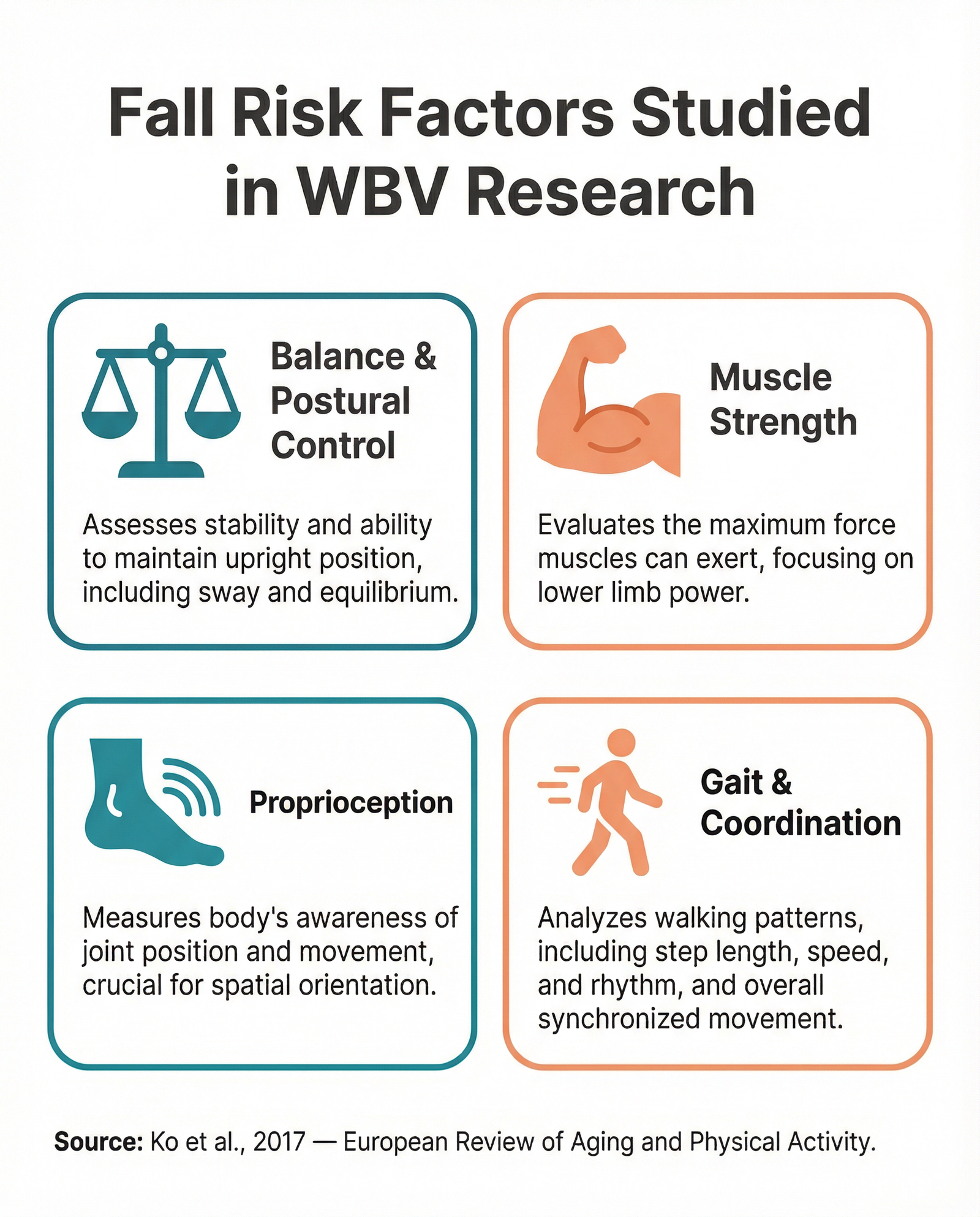
Ko and colleagues examined the existing body of research on WBV and fall-related outcomes in older adults — specifically, the parameters most directly linked to fall risk: balance, muscle strength, and gait performance. Reviews of this kind provide a broader perspective than individual trials, synthesising findings across multiple studies to identify consistent patterns in the evidence.
Why Falls Matter So Much — and Why Prevention Is Difficult
The consequences of falls in older adults extend far beyond the immediate injury. For many older individuals, a fall — even without serious physical injury — triggers a fear of falling that leads to voluntary activity restriction. This restriction accelerates deconditioning, which in turn increases fall risk further. It is a well-documented downward cycle.
Preventing falls requires maintaining the physical capacities that underpin stable movement: lower-limb strength, postural control, reaction time, and the neuromuscular coordination that allows the body to respond quickly to a perturbation. These capacities decline with age, and conventional exercise programmes — particularly resistance training and balance training — are effective but require a level of physical and cognitive engagement that many older adults, especially those in residential care, cannot sustain.
What the Researchers Examined
The review examined studies investigating WBV as an intervention targeting fall risk indicators in older adult populations. The focus was on outcomes most directly relevant to fall prevention — balance, lower-body muscle strength, and gait parameters — in community-dwelling and institutionalised older adults.
Whole-body vibration delivers a mechanical stimulus through a vibrating platform. The oscillation activates the neuromuscular system — engaging postural muscles and stimulating the sensory receptors involved in balance and proprioception — without requiring the participant to generate active resistance against an external load. This passive neuromuscular activation is at the centre of the hypothesis that WBV may be useful in fall risk reduction.
What the Researchers Found
The review concluded that WBV interventions showed positive effects on parameters associated with fall risk, including balance and lower-limb strength, in older adult populations. The findings supported the potential of WBV as a practical strategy for addressing fall risk indicators — particularly in populations where conventional exercise is limited by physical capacity or feasibility.
These findings are consistent with the physiological rationale: WBV stimulates the sensorimotor system in ways that may reinforce proprioceptive function and postural muscle activation, both of which are central to maintaining stability during movement.
Limitations and Practical Caveats
Review scope. The study examined WBV’s effects on fall risk parameters, not fall incidence itself. Improvements in balance and strength are associated with reduced falls — but the direct link between WBV and fewer falls requires long-term prospective studies in addition to intervention trials.
Population diversity. “Older adults” encompasses a broad range — from active community dwellers to frail nursing home residents. WBV effects may differ between these groups. Readers should consider which population sub-group is most relevant to their context.
WBV is not a fall prevention programme. The research examines WBV as a physical stimulus and its effects on fall-related physical parameters. It does not examine BGREEN products specifically, and the findings do not constitute medical claims about any commercial product.
Why This Is Relevant in Singapore’s Eldercare Context
Falls among older Singaporeans have healthcare system-level consequences. Beyond individual outcomes, each preventable fall averted reduces emergency department costs, rehabilitation burden, and caregiver strain. The Agency for Integrated Care and healthcare providers across Singapore are actively seeking evidence-based options to incorporate into fall prevention programmes.
For physiotherapists, occupational therapists, and eldercare programme managers, peer-reviewed reviews on WBV and fall risk provide a credible reference point when evaluating whether to incorporate vibration-based modalities into their activity programmes.
Learn More
The technology examined in this research — whole-body vibration — is at the core of BGREEN products. Our Science page explains how WBV works in accessible terms for both healthcare professionals and wellness-focused individuals.
To experience the technology directly, we offer complimentary sessions at our Wellness Lounge at The Adelphi, Singapore.
For eldercare and healthcare B2B enquiries, visit our Healthcare Partners page.
BGREEN and Turtlegym products are wellness and lifestyle equipment — not medical devices.
Source
- Ko MC, Liu WY, Lee YH, Chen CL, Wu YJ, Tseng TH. (2017). Effects of whole-body vibration exercise on fall risk factors in older adults: A systematic review. European Review of Aging and Physical Activity, 14, 11. https://doi.org/10.1186/s11556-017-0180-8
For the full research topic overview, visit our Research Library.