
Research Notice: Research cited on this page is independent, peer-reviewed scientific work. BGREEN and Turtlegym products are wellness and lifestyle equipment — they are not medical devices and are not intended to diagnose, treat, cure, or prevent any medical condition. Findings from independent research do not constitute claims about Vibrahealth products. Persons with health conditions should consult a qualified healthcare professional before use.
WBV and Knee Osteoarthritis: Muscle Activation Findings from a 2021 Study
Knee osteoarthritis (KOA) is among the most prevalent chronic musculoskeletal conditions affecting older adults. It is characterised by the progressive degradation of articular cartilage, changes in subchondral bone, and synovial inflammation — producing joint pain, stiffness, and reduced mobility that significantly impair quality of life. In Singapore, the prevalence of knee OA increases sharply with age, affecting a substantial proportion of adults over 60.
One of the less-discussed but clinically significant features of knee osteoarthritis is its impact on the neuromuscular system. Patients with KOA typically show altered muscle activation patterns around the knee — particularly in the quadriceps and other thigh muscles that provide joint stability. This neuromuscular deficit contributes to joint instability, pain amplification, and functional decline, and addressing it is a key target of physiotherapy and rehabilitation programmes.
In 2021, Zhang and colleagues published a study in BioMed Research International — a peer-reviewed, open-access journal published by Hindawi (Wiley) and indexed on PubMed — examining muscle activation patterns in knee osteoarthritis patients in the context of whole-body vibration (WBV).
About the Study
BioMed Research International is a broad-scope, peer-reviewed journal covering biomedical science, clinical medicine, and health services research. It is published by Hindawi Limited (part of Wiley) and is indexed on PubMed and the Science Citation Index Expanded.
Zhang and colleagues’ 2021 study (Article ID 6671390) examined the relationship between WBV and muscle activation in individuals with knee osteoarthritis — focusing specifically on the neuromuscular characteristics of this population when exposed to vibration stimulus.
Why Neuromuscular Function Matters in Knee OA
In a healthy knee, the muscles surrounding the joint — primarily the quadriceps, hamstrings, and hip abductors — act as dynamic stabilisers. They absorb load, control movement, and protect the articular surfaces from excessive stress. In knee osteoarthritis, this protective function is compromised.
Research consistently shows that KOA patients have reduced quadriceps strength and altered activation timing compared to age-matched controls without OA. This pattern — sometimes called arthrogenic muscle inhibition — occurs when joint pain and swelling inhibit motor neuron activity, leading to voluntary and reflex muscle activation deficits even when the patient attempts to generate force.
The consequence is a cycle: reduced muscle activation leads to less joint protection, which increases cartilage loading and pain, which further inhibits muscle function. Rehabilitation strategies that can restore or maintain appropriate muscle activation around the knee are therefore central to managing KOA-related functional decline.
What the Researchers Examined
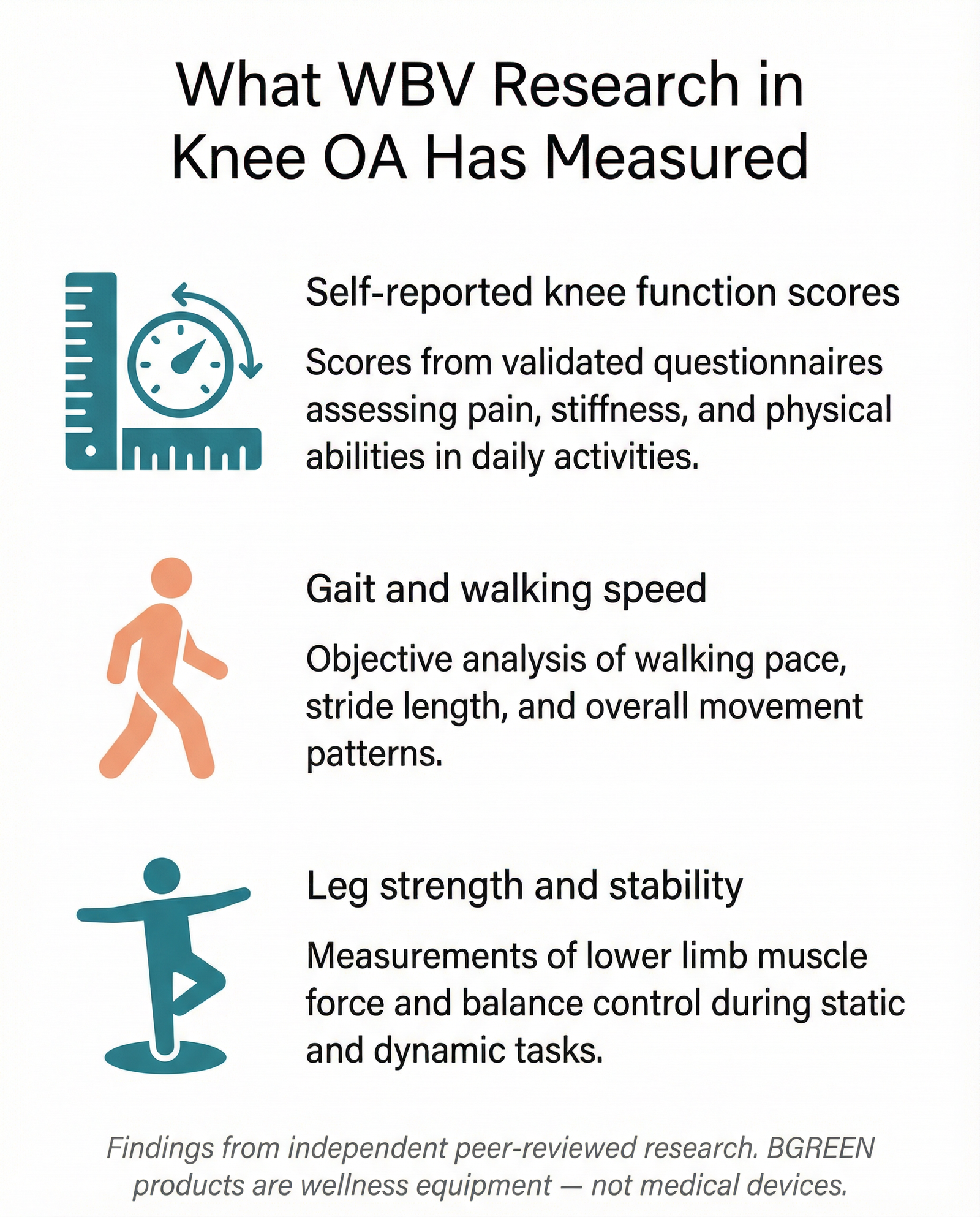
Zhang and colleagues investigated muscle activation characteristics in KOA patients, examining how WBV interacts with the neuromuscular profile of this population. The study used objective measurement of muscle activation — examining electromyographic (EMG) or related measures of muscle activity — to characterise the neuromuscular response to vibration in the context of knee osteoarthritis.
Understanding how WBV engages the muscles of the lower limb in a population with established neuromuscular deficits provides mechanistic and clinical insight into whether vibration-based modalities may be relevant for this condition.
What the Researchers Found
The study found that WBV produced measurable effects on muscle activation in knee osteoarthritis patients. The researchers documented how vibration stimulus influenced the neuromuscular activity of the muscles studied in the KOA population — providing evidence that WBV engages the lower limb musculature in individuals with this condition.
These findings are relevant to the clinical rationale for using WBV in KOA patients: if vibration can activate the muscles that are inhibited by joint pain and arthrogenic muscle inhibition, it may offer a low-load, low-pain approach to maintaining neuromuscular engagement in a population where conventional strengthening exercises are limited by pain and swelling.
Understanding the Scope of This Research
Cross-sectional or mechanistic focus. Research examining muscle activation patterns in response to a stimulus provides mechanistic insight — it answers how the muscles respond, rather than whether WBV reduces pain or improves long-term function in KOA patients. Both types of evidence are valuable, and this study contributes to the mechanistic layer.
KOA is a heterogeneous condition. Knee osteoarthritis ranges from mild radiographic changes to severe structural joint disease. The population characteristics and disease severity in this study define who the findings most directly apply to.
WBV is not a treatment for osteoarthritis. The research investigates WBV as a physical stimulus in individuals with KOA. It does not examine BGREEN products specifically, and findings from this study do not constitute medical claims about any wellness device.
Why This Research Is Relevant
Knee osteoarthritis is extremely common among the ageing population that Vibrahealth’s products serve. For physiotherapists, rehabilitation medicine specialists, and corporate wellness managers working with sedentary adults at risk of KOA, understanding the neuromuscular effects of WBV in this population adds an important dimension to the evidence base.
The fact that this research examines muscle activation specifically — rather than pain as the sole outcome — reflects a more sophisticated understanding of KOA as a neuromuscular as well as structural condition. It opens the question of whether vibration-based physical activity can help maintain the muscle function that protects the knee joint in individuals living with OA.
Learn More
Our Science page explains the mechanisms behind whole-body vibration and how it interacts with the neuromuscular and musculoskeletal systems. For those who want to experience the technology, complimentary sessions are available at our Wellness Lounge at The Adelphi, Singapore.
BGREEN and Turtlegym products are wellness and lifestyle equipment — not medical devices.
Source
- Zhang J, Zhang Z, Lu H, Zhang W, Huang Z, Sun Q, Wang W. (2021). Muscle activation and vibration frequency: A study of whole-body vibration in patients with knee osteoarthritis. BioMed Research International, 2021, Article ID 6671390. https://doi.org/10.1155/2021/6671390