
Research Notice: Research cited on this page is independent, peer-reviewed scientific work. BGREEN and Turtlegym products are wellness and lifestyle equipment — they are not medical devices and are not intended to diagnose, treat, cure, or prevent any medical condition. Findings from independent research do not constitute claims about Vibrahealth products. Persons with health conditions should consult a qualified healthcare professional before use.
Whole Body Vibration in Nursing Homes: What a 2024 Meta-Analysis Found
For older adults living in nursing homes and residential care facilities, maintaining physical function is one of the most meaningful determinants of independence and dignity. Declining muscle strength, reduced balance, and limited mobility increase the risk of falls, accelerate loss of independence, and place an enormous burden on care staff. Researchers have been studying whether whole-body vibration (WBV) — a passive, low-effort physical stimulus — could be a practical option for this population.
In 2024, a team of researchers published a systematic review and meta-analysis in Physical Therapy, the official journal of the American Physical Therapy Association (published by Oxford University Press), specifically examining what the research says about WBV in nursing home residents over the age of 80.
About This Review
The review was conducted by Borja Sañudo and colleagues across three institutions: the Universidad de Sevilla (Spain), Escola Superior de Saúde Fernando Pessoa (Portugal), and Nottingham University Hospitals NHS Trust (United Kingdom). It was published in February 2024.
A systematic review with meta-analysis occupies the highest tier of scientific evidence — Level 1a. Rather than relying on a single study, the researchers searched three major medical databases (MEDLINE, Scopus, and CINAHL) to identify all qualifying randomised controlled trials on this question, then combined their results statistically to draw broader conclusions.
What the Researchers Examined
The review focused specifically on nursing home residents older than 80 years — a population that is frequently excluded from general exercise research because of their age, frailty, and limited mobility. The researchers included only studies that:
- Involved nursing home residents over 80 years old
- Compared WBV intervention against non-intervention, usual care, or placebo
- Measured physical function outcomes including strength, balance, gait, and mobility
This specificity is important. The question was not whether WBV benefits middle-aged athletes or younger sedentary adults. The question was whether it has a meaningful effect in the most physically vulnerable elderly population — those already living in residential care.
What the Researchers Found
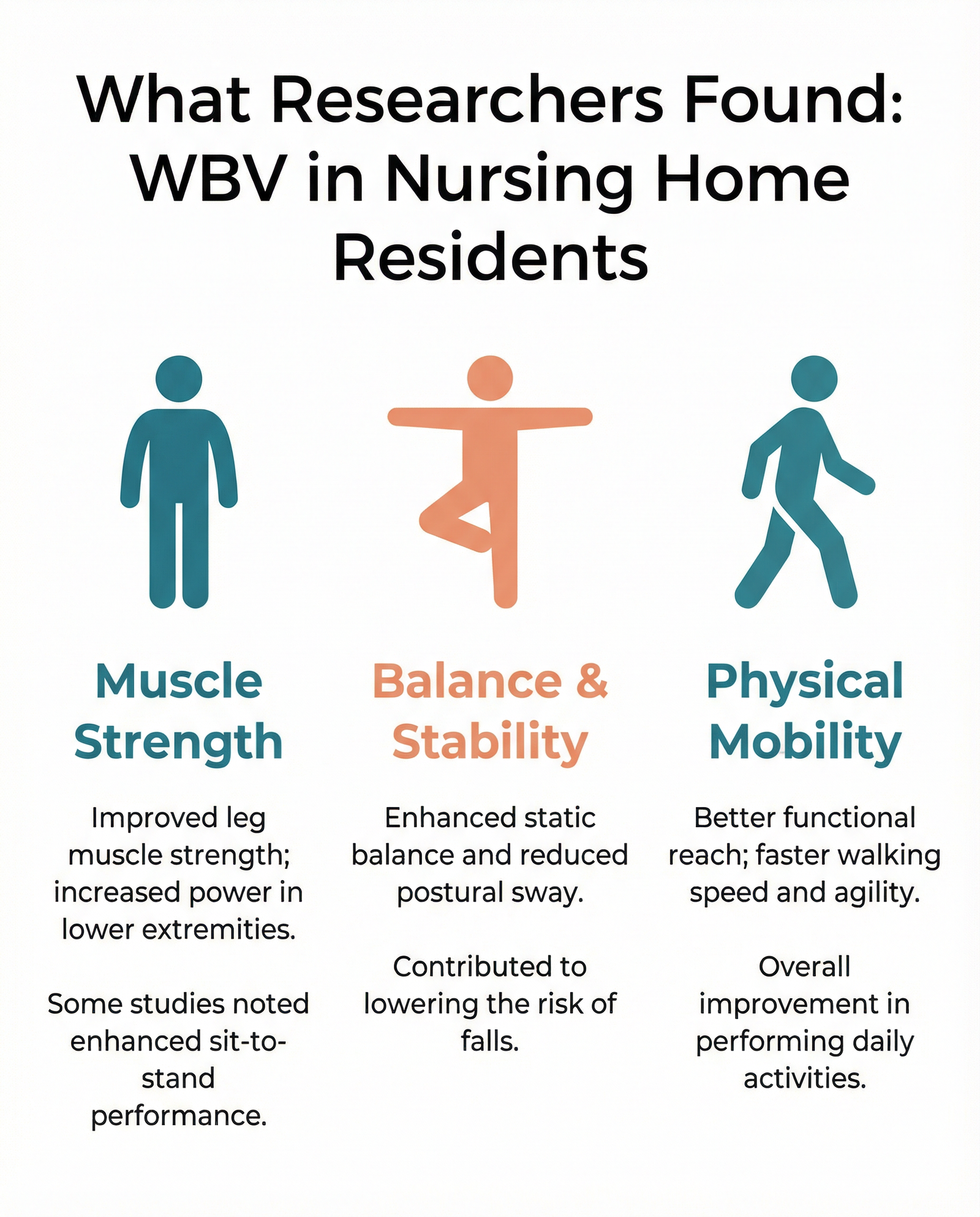
The meta-analysis found that WBV interventions had positive effects on the physical function parameters studied in nursing home residents over 80 years of age.
Specifically, researchers reported improvements in outcomes related to strength, balance, and mobility across the included studies. The review concluded that WBV represents a promising option for improving physical function in this population — and notably, the research was conducted in the context of care institutions where exercise options are often limited by participants’ physical condition and available supervision.
The authors — including a geriatric medicine specialist from Nottingham University Hospitals NHS Trust — noted that loss of functional independence in institutionalised older adults is a consequence of declining muscle mass and reduced force production capacity, and that practical interventions are needed for this setting.
Understanding the Evidence and Its Limitations
As with any systematic review, the quality of the conclusions depends on the quality of the individual studies included. The researchers applied rigorous inclusion criteria and assessed the risk of bias across the included trials.
It is worth noting several important caveats that apply to all WBV research in this population:
The population is specific. These findings relate to nursing home residents over 80 — a group with particular physical and health characteristics. Outcomes may differ in younger or healthier populations, or in those who are able to engage in conventional exercise.
WBV protocol matters. Different studies used different vibration frequencies, amplitudes, session durations, and supervision levels. The meta-analysis examined the aggregate effect; specific protocols may vary in their outcomes.
WBV was studied as an intervention, not as a replacement for medical care. The research examines WBV as a physical stimulus. It does not examine BGREEN products specifically, and the findings do not constitute claims about any commercial product.
Why Healthcare Professionals Are Paying Attention
What makes this review significant for eldercare settings is its population focus. Most WBV research has been conducted in community-dwelling older adults who are relatively mobile and independent. The Sañudo et al. review deliberately addressed the gap in evidence for nursing home residents — a group for whom standard exercise interventions are often impractical.
For physiotherapists, nursing home administrators, and eldercare managers evaluating physical activity options for residents, a 2024 meta-analysis from Oxford University Press in one of rehabilitation science’s most respected journals provides a credible reference point.
Learn More
The technology examined in this research — whole-body vibration — is what BGREEN products are built around. If you are a healthcare professional or care facility manager interested in understanding how WBV technology works, our Science page explains the mechanism behind both WBVV and WBPA in plain language.
To experience the technology directly, we offer complimentary sessions at our Wellness Lounge at The Adelphi, Singapore. BGREEN and Turtlegym products are wellness and lifestyle equipment — they are not intended to treat or manage any medical condition.
For eldercare and healthcare B2B enquiries, visit our Healthcare Partners page.
Source
- Sañudo B, Reverte-Pagola G, Seixas A, Masud T. (2024). Whole-Body Vibration to Improve Physical Function Parameters in Nursing Home Residents Older Than 80 Years: A Systematic Review With Meta-Analysis. Physical Therapy, 104, pzae025. https://doi.org/10.1093/ptj/pzae025