Creating a Daily Wellness Routine That Actually Sticks
Most wellness routines fail within three weeks. Not because people lack willpower. Not because the goals are wrong. But because the routine was designed for someone with more time, more energy, and fewer physical limitations than the person trying to follow it.
For older adults — and for the adult children trying to support them — this failure cycle is deeply familiar. Join the gym. Go twice. Stop. Try a walking group. Miss a session. Feel guilty. Stop. Buy equipment. Use it once. Store it under the bed.
The research on habit formation is clear on what actually works. And it turns out to be almost the opposite of how most wellness programmes are designed.
Why Most Wellness Routines Fail After 60
The standard model for building a wellness routine looks something like this: set a goal, block out time, push through resistance, reward yourself. This model works reasonably well when the barriers are primarily psychological — when the body is capable but the mind is reluctant.
For older adults, the barriers are often physical as much as they are psychological:
- Chronic joint discomfort makes some activities genuinely painful to start
- Fatigue — from disrupted sleep, medication side effects, or simply the energy cost of managing multiple health concerns — reduces the available willpower for "effortful" activities
- Fear of falling, embarrassment in public settings, or anxiety about exacerbating a condition all create invisible friction that standard habit models do not account for
- Recovery time after activity is longer — meaning a session that leaves a 40-year-old refreshed might leave a 70-year-old needing a lie-down
A wellness routine that ignores these realities is not a wellness routine. It is a source of shame disguised as a health recommendation.
The Science of What Actually Sticks
Behavioural science researcher BJ Fogg's work on habit formation identifies three elements that predict whether a behaviour will persist: motivation, ability, and prompt. For older adults, ability is often the constraining factor — and increasing ability means reducing friction, not increasing motivation.
In practical terms, this means the most sustainable wellness activities for older adults share certain characteristics:
- Low barrier to start — no special equipment to set up, no changing required, no journey to a venue
- Short session length — 10–20 minutes is far more sustainable than 45-minute sessions that require recovery time
- Comfortable rather than challenging — the activity should feel pleasant, or at worst neutral, not difficult or painful
- Consistent prompt — linked to an existing daily habit (after breakfast, before the evening news, while watching television)
- Observable benefit — the person should feel something positive within the same session or by the next morning
A Realistic Daily Wellness Routine for Adults Over 60
Here is what a sustainable daily wellness routine might look like for an older adult in Singapore, built around these principles. This is a framework, not a prescription — adjust based on what is realistic for your specific situation.
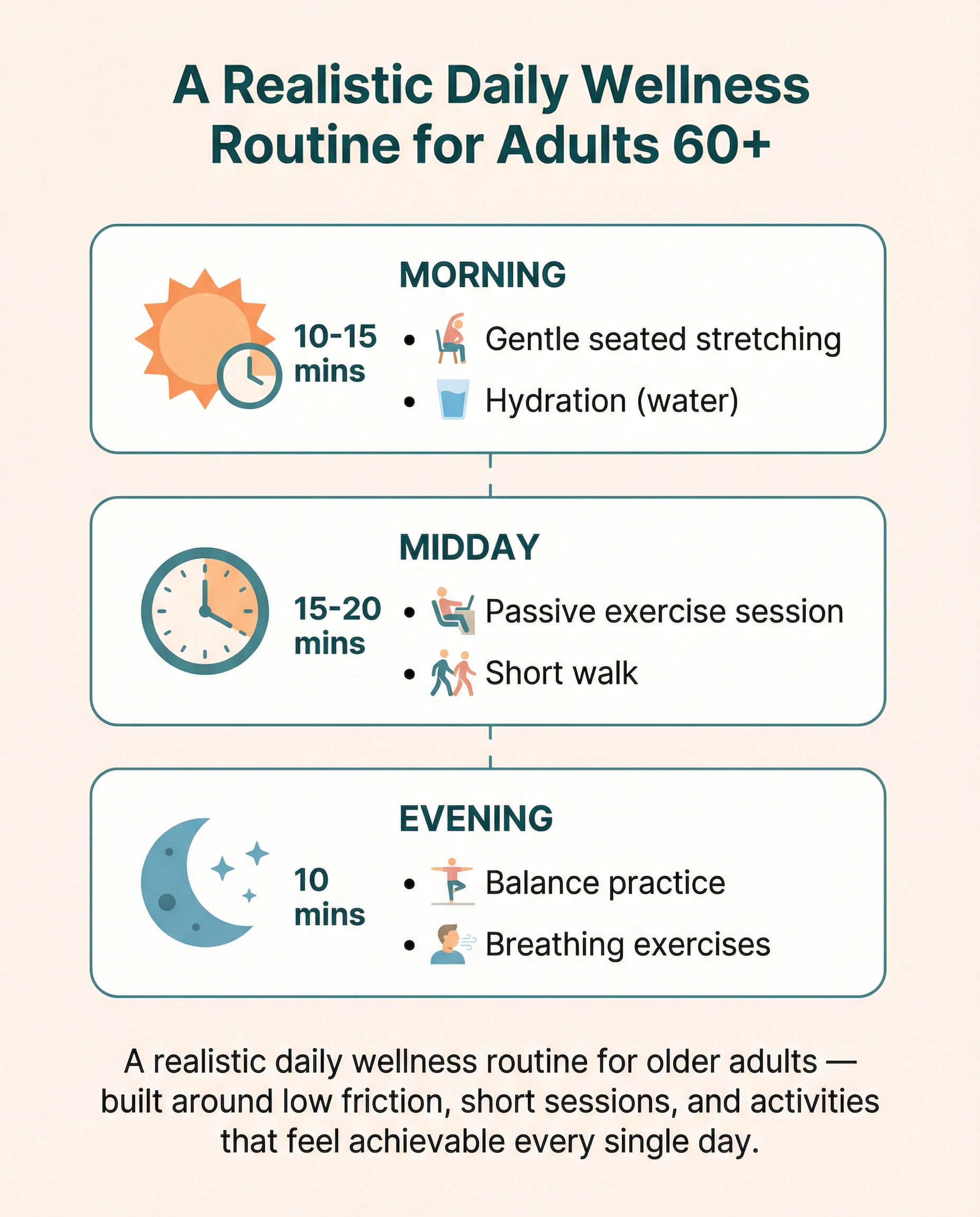
Morning (10–15 minutes)
- Gentle seated stretching — 5 minutes of neck rolls, shoulder rolls, and ankle circles before getting out of bed. Reduces morning stiffness and warms up joints before weight-bearing.
- Hydration — a glass of water before anything else. Dehydration is a common and underappreciated contributor to fatigue and poor circulation in older adults.
- Light movement — a slow walk to the kitchen, a few minutes standing at the window. The goal is not exercise — it is waking the body up gently.
Midday or Early Afternoon (15–20 minutes)
- Passive exercise session — for those using whole body vibration technology, this is the ideal time slot. The body is warmed up from morning activity, energy levels are typically at their peak, and the session can be completed seated with no preparation. A 15-minute session supports circulation, gentle muscle activation, and lymphatic flow without requiring exertion or recovery time.
- Short walk — even 10 minutes of gentle walking after lunch supports blood sugar management and circulation. Hawker centre and back counts.
Evening (10 minutes)
- Balance practice — standing on one foot while holding a stable surface, heel-to-toe walking along a wall, or simple standing calf raises. Fall prevention is one of the most important yet underaddressed aspects of healthy ageing in Singapore.
- Wind-down breathing — 5 minutes of slow, deliberate breathing before bed. Supports sleep quality, which directly affects next-day energy and motivation.
The Role of Passive Exercise in a Sustainable Routine
One of the most common barriers to exercise adherence in older adults is the exertion cost — the physical and psychological effort required to get started. This is why passive exercise, specifically whole body vibration technology, fits so naturally into a sustainable routine.
A 15-minute session on a BGREEN vibration chair or sofa:
- Requires no warm-up
- Requires no changing of clothes
- Can be done seated, making it accessible regardless of mobility level
- Produces no delayed-onset muscle soreness or recovery requirement
- Delivers genuine physiological engagement — circulation support, gentle muscle activation, lymphatic stimulation — that many users describe as feeling "like they have done something" without having exerted themselves
For older adults who find conventional exercise inaccessible or aversive, this is not a shortcut. It is a genuinely different category of wellness activity — one that makes daily consistency achievable for people for whom it otherwise would not be.
You can learn more about the technology on our How It Works page or explore our product range.
Tips for Caregivers: Building a Routine With (Not For) Your Parent
If you are trying to help an elderly parent establish a wellness routine, the most important principle is co-creation over prescription. A routine that the older adult helped design is far more likely to persist than one handed to them fully formed.
Some practical approaches:
- Ask what they already enjoy — walking to the market, morning Tai Chi in the park, watching the news at a fixed time. Build the wellness routine around existing anchors rather than displacing them.
- Start smaller than seems necessary — a 5-minute walk every day is better than a 30-minute walk that happens twice before being abandoned. Momentum matters more than volume.
- Remove decisions — lay out what is needed the night before, establish a fixed time, link the activity to a cue that already exists in their day. Decision fatigue is real, especially when managing multiple health concerns.
- Celebrate observable wins — sleeping better, less morning stiffness, walking to the letterbox without hesitation. These are real outcomes worth acknowledging.
For more on navigating these conversations, see our guide on how to talk to your parents about exercise without starting an argument.
Frequently Asked Questions
How much exercise should a 70-year-old do per day?
Singapore's Health Promotion Board recommends adults aim for at least 150 minutes of moderate-intensity activity per week. For older adults managing health conditions, spreading this across shorter daily sessions (20–30 minutes) is generally more sustainable and safer than longer, less frequent sessions. Always check with your doctor if you have specific health conditions.
What is the best time of day for elderly people to exercise?
Most older adults find mid-morning to early afternoon the most sustainable window — energy is higher than in the evening, joints are warmed up from morning activity, and there is less risk of post-exercise fatigue affecting sleep. That said, the best time is whatever time the person will actually use consistently.
How do you motivate an elderly person to exercise?
Motivation is rarely the primary barrier for older adults — physical discomfort, fear of injury, and logistical friction are usually bigger obstacles. Reducing these barriers — through low-impact activities, comfortable settings, and removing preparation requirements — is more effective than motivational approaches alone.
What is passive exercise and is it effective for seniors?
Passive exercise refers to physical activity where the body receives movement or stimulation without active muscular effort from the person. Whole body vibration is one form — the technology delivers vibrations that trigger involuntary muscle responses, supporting circulation and muscle activation without requiring the person to exert themselves. It is increasingly used alongside conventional physiotherapy for older adults with mobility limitations. Our products are wellness equipment and are not medical devices.
Vibrahealth offers complimentary sessions at our Wellness Lounge at The Adelphi, Singapore. If you are looking for a gentle, sustainable addition to your wellness routine, WhatsApp us or book a free trial.
Our products are general wellness equipment, not medical devices. Please consult a qualified healthcare professional before making changes to your health routine.