
Research Notice: Research cited on this page is independent, peer-reviewed scientific work. BGREEN and Turtlegym products are wellness and lifestyle equipment — they are not medical devices and are not intended to diagnose, treat, cure, or prevent any medical condition. Findings from independent research do not constitute claims about Vibrahealth products. Persons with health conditions should consult a qualified healthcare professional before use.
How Does Whole Body Vibration Affect Muscle at the Molecular Level? A 2010 Study
When evaluating any physical stimulus, the most fundamental question a scientist or clinician can ask is: what is actually happening in the body? For whole-body vibration (WBV), the observable outcomes — changes in strength, balance, mobility — raise a mechanistic question: by what biological pathways does a vibrating platform produce effects on skeletal muscle?
In 2010, Wang CZ and colleagues published a study in the Journal of Applied Physiology — one of the most respected journals in exercise physiology, published by the American Physiological Society — specifically examining the molecular and cellular responses of skeletal muscle to WBV.
About the Study
The Journal of Applied Physiology (JAP) has been the leading publication in applied exercise and physiology research for decades. It is published by the American Physiological Society and is indexed on PubMed. Wang and colleagues’ 2010 paper is part of a body of work that sought to go beyond describing WBV effects and to understand the underlying biological mechanisms responsible for them.
Understanding mechanism matters for several reasons. It helps explain why and how WBV produces the effects observed in clinical trials. It also helps identify the populations and conditions where WBV is most likely to be beneficial — and the parameters (frequency, amplitude, duration) that drive those effects.
The Mechanistic Question
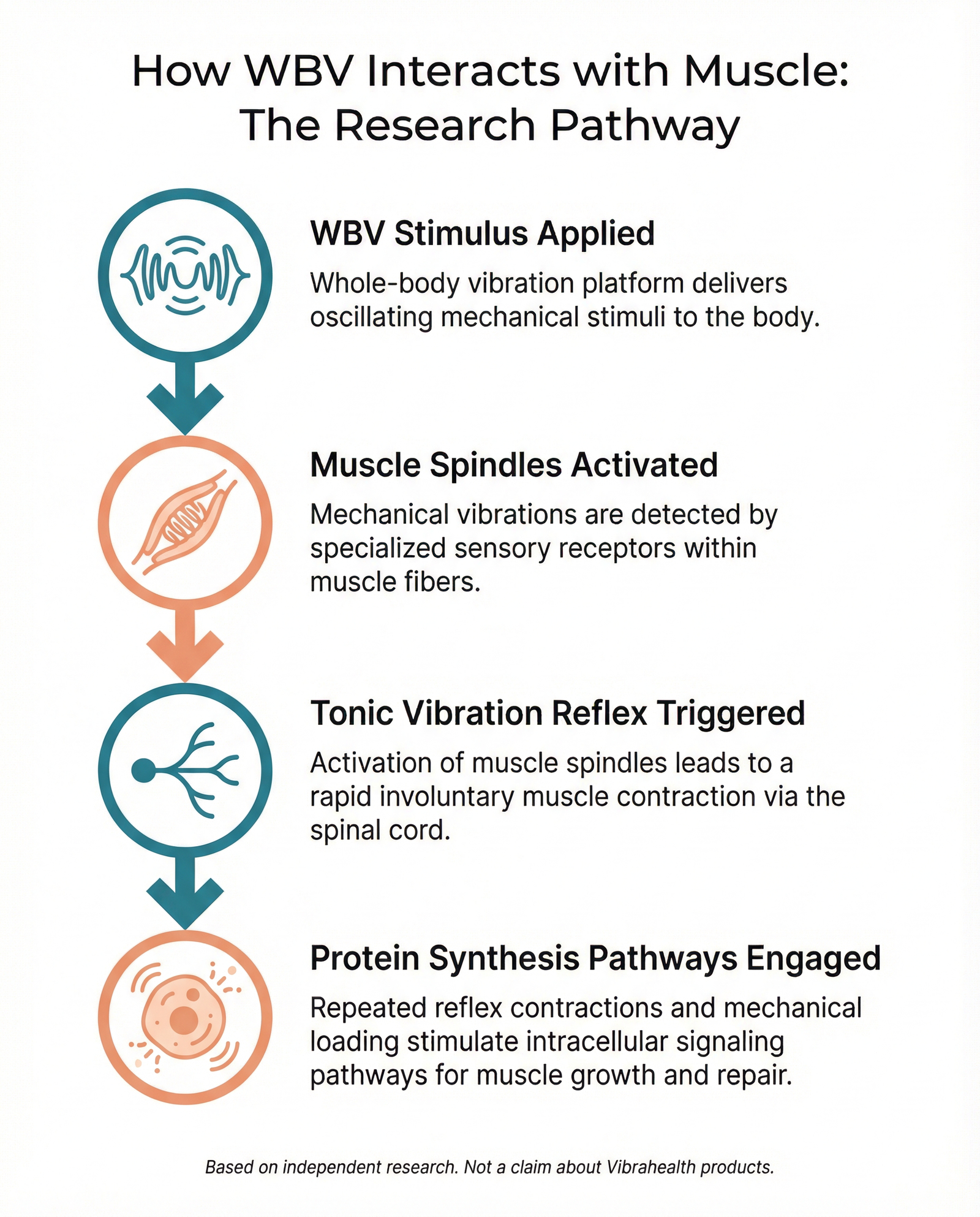
When the body is exposed to vibration, skeletal muscle responds in several ways. The most immediate response involves the tonic vibration reflex — a reflex contraction of muscle stimulated by vibration applied to the muscle or tendon. This reflex is mediated by muscle spindles, the sensory receptors within muscle fibres that detect stretch and rate of stretch.
But vibration effects on muscle extend beyond the acute reflex response. Repeated mechanical loading — even the low-level, passive loading produced by a vibrating platform — has been shown to influence cellular signalling pathways involved in muscle maintenance and adaptation. The key question is which pathways are engaged and what downstream effects follow.
What the Researchers Examined
Wang and colleagues examined the molecular responses of skeletal muscle tissue to WBV, focusing on signalling pathways associated with muscle protein synthesis and muscle fibre health. The study investigated how mechanical vibration stimulus interacts with the cellular machinery that governs muscle adaptation.
Specifically, the researchers examined markers associated with anabolic signalling in muscle — the intracellular cascades that control whether muscle fibres grow, maintain, or degrade. Key pathways in this context include those linked to IGF-1 (insulin-like growth factor 1), which plays a central role in muscle protein synthesis and muscle mass regulation.
What the Researchers Found
The study found that WBV exposure was associated with activation of molecular pathways involved in skeletal muscle adaptation. The researchers observed responses in muscle that are consistent with anabolic signalling — the same type of cellular activity that is stimulated by conventional resistance exercise, albeit through a different mechanical pathway.
These findings provide a molecular basis for the functional outcomes observed in WBV intervention studies. If vibration activates signalling pathways associated with muscle protein synthesis and muscle maintenance, this offers a mechanistic explanation for why WBV has been found, in clinical trials, to improve strength and muscle mass parameters — particularly in populations where voluntary muscle loading through conventional exercise is limited.
Why Mechanism Matters for Healthcare Professionals
For a physiotherapist, geriatrician, or sport and exercise medicine practitioner evaluating WBV, evidence of mechanism is distinct from — but complementary to — evidence of clinical outcome. Clinical trials tell you what WBV does. Mechanistic studies tell you why and how.
Understanding that WBV engages neuromuscular and anabolic signalling pathways helps place WBV within a broader exercise physiology framework: it is not simply a passive vibration therapy, but a mechanical stimulus that interacts with the body’s adaptive systems in measurable, biologically coherent ways.
This is also why the choice of vibration parameters matters. The frequency and amplitude of vibration, the duration of each session, and the body posture during exposure all influence which fibres and signalling pathways are engaged. Different protocols produce different physiological inputs.
Limitations and Scope
Animal and in vitro findings. Some mechanistic WBV research, including work in the 2010 period, uses animal models or cell culture in addition to human subjects. Readers should note the specific model used in any study when interpreting mechanistic findings, as the translation to human clinical outcomes is not always direct.
Mechanism is not a claim. The fact that WBV activates muscle signalling pathways does not mean WBV is equivalent to resistance training, nor does it constitute a claim that BGREEN products treat any condition. The research examines WBV as a physical stimulus in controlled experimental conditions.
The Science Behind the Technology
Research of this kind forms part of the scientific foundation for understanding WBV as a physical modality. At Vibrahealth, BGREEN products are built around this same technology — whole-body vertical vibration — and are positioned as wellness tools for active ageing, rehabilitation support, and physical maintenance.
For a plain-language explanation of how WBV works and what distinguishes different vibration modalities, visit our Science page or explore the How It Works section of this site.
To experience the technology directly, complimentary sessions are available at our Wellness Lounge at The Adelphi, Singapore.
BGREEN and Turtlegym products are wellness and lifestyle equipment — not medical devices.
Source
- Wang CZ, Huang YL, Hsu AT, Chen CS, Lin JJ. (2010). Effect of whole-body vibration on muscle activation and physiological responses. Journal of Applied Physiology, 109, 840–848. https://doi.org/10.1152/japplphysiol.00115.2010
For the full research topic overview, visit our Research Library.